
By Tarik, Senior HVAC Specialist at Air Climatisation VS
Quick Takeaway
A cold-climate heat pump is designed to provide stronger heating performance at lower outdoor temperatures than a conventional model. However, winter comfort still depends on proper sizing, published low-temperature capacity, the home’s layout, and the backup-heating plan.
The words “cold climate” are useful, but they do not replace a complete assessment of the house.
What Cold-Climate Performance Really Means
A cold-climate heat pump is an air-source heat pump designed and tested for stronger performance at lower Canadian temperatures. Natural Resources Canada’s heat-pump guidance explains that these systems are better adapted to colder conditions than conventional models.
However, the cold-climate designation does not mean that every model provides the same heating output. The system must still be matched to the home.
Think of a vehicle climbing a steep hill. It may continue moving, but it may not maintain the same speed or carry the same load as it would on level ground. In the same way, a heat pump can continue operating while its available heating capacity and efficiency change as the outdoor temperature falls.
Homeowners should compare three different specifications:
- Heating capacity at lower temperatures: This shows how much heat the equipment can produce under colder conditions. The nominal capacity in a model name does not necessarily represent its winter output.
- Minimum operating temperature: This is the manufacturer’s operating limit, not a guarantee that the unit can heat an entire house at that temperature.
- COP and HSPF2: COP compares the heat delivered with the electricity consumed at a specific test condition. HSPF2 represents estimated efficiency over a heating season.
Hydro-Québec notes that minimum operating temperatures vary between heat-pump models. The specific equipment data should therefore be compared with the home’s calculated heating requirements.
Balance Point and Backup Heating
The thermal balance point is the outdoor temperature at which the heat pump’s available output matches the amount of heat the home is losing.
Above that point, the heat pump may be able to meet the heating demand by itself. Below it, backup heating supplies the difference.
The balance point varies according to the equipment, insulation, windows, air leakage, home size, layout, and preferred indoor temperature. This is why one manufacturer temperature rating cannot predict comfort in every house.
Possible backup configurations include:
- Electric baseboards with a wall-mounted heat pump
- Electric auxiliary heating in a central system
- A central heat pump connected to an electric furnace
- A central heat pump paired with an existing gas furnace
Using backup heat during colder periods does not mean that the heat pump is unsuitable. It means the complete heating system has been planned for changing winter conditions.
Wall-Mounted or Central for Winter Comfort?
Equipment performance is only one part of winter comfort. The heat must also reach the rooms where it is needed.
A wall-mounted heat pump primarily serves the areas its airflow can reach. Open living spaces may be easier to cover than closed bedrooms, finished basements, or rooms on another floor. A multisplit system can provide more zones when one indoor unit is not enough.
Homeowners considering a ductless option can review wall-mounted heat pump installation before deciding how many areas require direct coverage.
A central heat pump distributes air through the home’s ductwork. This can provide more complete coverage when the ducts are properly sized, routed, and balanced. Homes with an existing forced-air system can explore central HVAC installation planning.
Why Proper Sizing Still Matters
Choosing the largest available unit is not automatically the safest approach. An oversized system may cycle unnecessarily during milder weather, create uneven temperatures, and provide less effective summer humidity control. An undersized system may depend too heavily on backup heating.
Even variable-capacity equipment should be selected according to the home’s heating and cooling requirements, low-temperature output, layout, insulation, existing heating equipment, and heat distribution.
Outdoor Placement and Defrost Operation
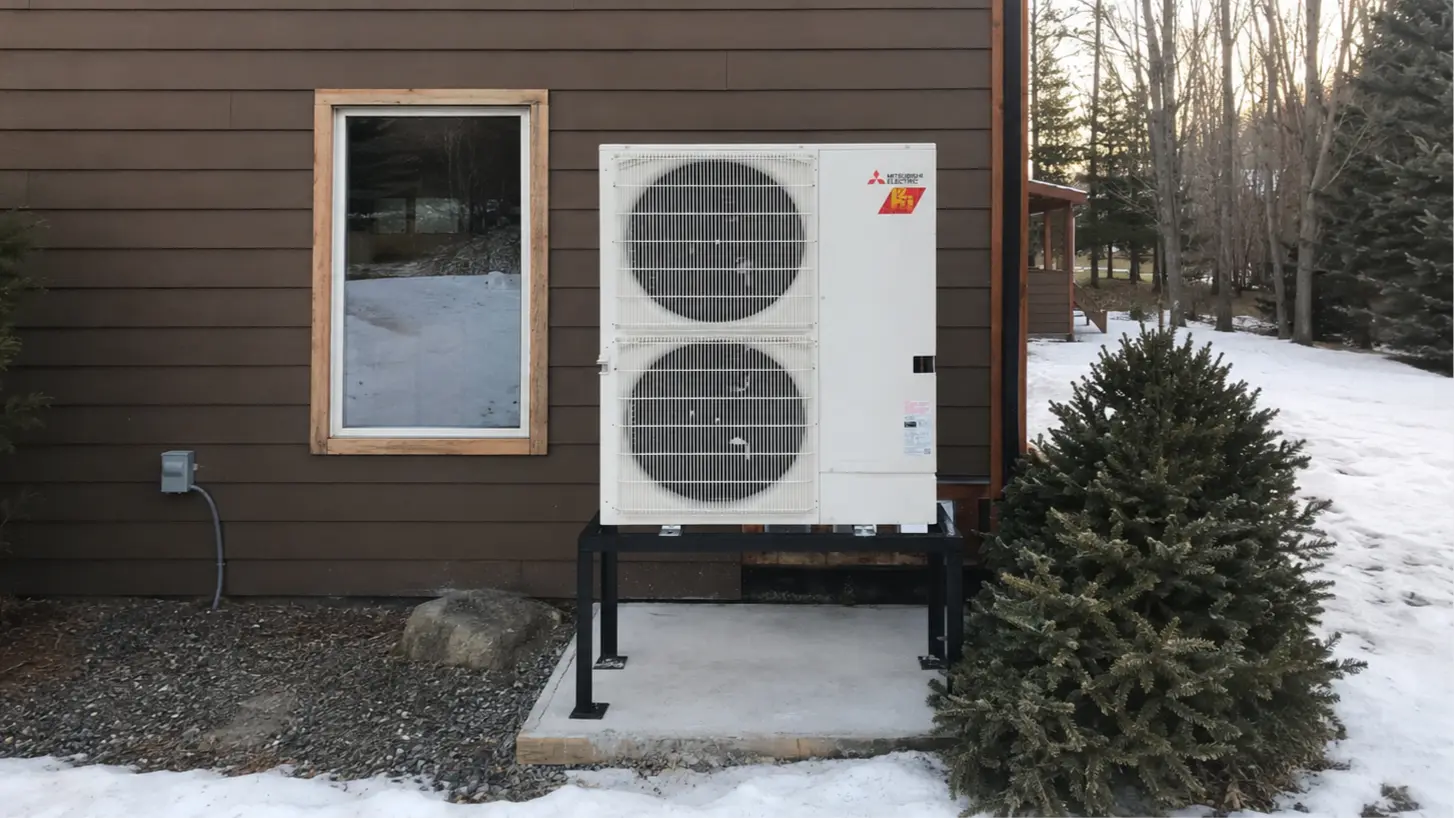
The outdoor unit must remain accessible to air during the winter. Installation planning should account for elevation above expected snow accumulation, clearance around the unit, drainage, and the possibility of falling snow or ice.
During heating operation, frost can form on the outdoor coil. The system periodically enters a defrost cycle to remove it. Water, vapour, or temporary steam around the outdoor unit during this cycle can be normal.
The installation should provide a suitable path for defrost water so it does not create persistent ice around the equipment or nearby walking areas.
What a FREE HVAC Estimation Visit Should Review
A useful estimation visit looks beyond the cold-climate label. For an Île Perrot home, the assessment should consider:
- The home’s size, layout, and heat distribution
- Insulation and visible air-leakage concerns
- Existing baseboards, furnace, or central system
- Rooms that are difficult to keep comfortable
- Electrical capacity
- Published low-temperature heating performance
- Outdoor-unit placement
- The role of backup heating
- Whether a wall-mounted, multisplit, or central system fits the property
This information helps determine how the complete heating system should work, not just which outdoor unit to purchase.
Frequently Asked Questions
Can a cold-climate heat pump heat an entire Île Perrot home?
It may be able to provide most or all of the required heat, depending on the home’s heating load, the system’s low-temperature capacity, and how effectively heat is distributed. A room-by-room assessment is particularly important in multi-storey homes or properties with closed rooms and finished basements.
Does a cold-climate heat pump still need backup heating?
It often makes sense to retain or plan a backup source for colder periods or areas outside the heat pump’s effective coverage. The backup could be electric baseboards, auxiliary elements in a central system, or a compatible furnace.
What is the difference between a standard and cold-climate heat pump?
A cold-climate model is designed and tested for stronger performance at lower outdoor temperatures. However, the designation alone does not show how much heat a specific model will provide in a particular home. Low-temperature capacity and proper sizing still need to be reviewed.
Book a FREE HVAC Estimation Visit
Planning a heat-pump installation in Île Perrot? Book a FREE HVAC Estimation Visit with Air Climatisation VS to compare cold-climate systems, review winter heating requirements, and plan an appropriate backup-heating strategy.