
By Tarik, Senior HVAC Specialist at Air Climatisation VS
Quick Takeaway
Choosing between a wall-mounted heat pump and a central HVAC system depends mainly on the home itself: existing ductwork, number of floors, room layout, comfort issues, and how evenly you want heating and cooling distributed. On the South Shore, many bungalows, semi-detached homes, condos, and townhouses can work with either option. The smart choice is not always the biggest system or the most impressive brochure, because air has the annoying habit of following physics instead of marketing.
Two systems, two different comfort strategies
A wall-mounted heat pump and a central HVAC system can both heat and cool a home, but they manage comfort in very different ways.
A wall-mounted heat pump usually works by zone. It is installed on an interior wall and delivers air directly into the space where it is located. This can be practical for an open-concept area, condo, addition, finished basement, or home without ductwork.
A central HVAC system uses ductwork to distribute air through multiple rooms. It may be connected to a central heat pump, furnace, central air conditioning system, or a combination of equipment. When the ductwork is properly designed, a central system can provide more even comfort throughout the home.
What a wall-mounted heat pump does well
A wall-mounted heat pump is often a strong option when the home does not already have ductwork, or when adding ductwork would be too invasive.
It can make sense for many common South Shore situations:
- A condo in Brossard or Longueuil
- A townhouse with an open main floor
- A bungalow without existing ducts
- A home addition built after the original construction
- A finished basement that needs better temperature control
- A main living area where the family spends most of its time
Think of a wall-mounted heat pump like a well-placed lamp. It can do a great job lighting one area, but it does not automatically light the entire house. Air works in a similar way, because apparently invisible comfort needs logistics too.
Advantages of a wall-mounted heat pump
A wall-mounted heat pump usually involves less invasive work than a central system when there is no ductwork in the home. It also allows you to target a specific zone instead of treating the entire house as one big box.
This can be useful when the home has a large open-concept main floor or when one level needs more comfort than the rest. In some cases, a multisplit system can also connect multiple indoor units to one outdoor unit, helping manage several zones.
Limits to consider
A wall-mounted heat pump does not distribute air the same way as a central HVAC system. Hallways, closed bedrooms, and rooms far from the indoor unit may receive less conditioned air, especially when doors are closed.
That is why placement matters. Unit location, capacity, airflow direction, and room layout can all change the result. Installing an undersized or poorly placed unit is a bit like putting one fan in a corner and hoping the whole house becomes reasonable. Optimistic, but not exactly engineering.
What a central HVAC system does better
A central HVAC system is usually better suited to homes that already have ductwork in good condition, or for homeowners who want a more integrated whole-home comfort solution.
On the South Shore, this option can be useful for:
- Detached homes with existing ductwork
- Bungalows with a central furnace
- Homes with several bedrooms
- Multi-level homes
- Families looking for more even temperatures
- Replacement or upgrade projects involving an existing central system
With a central system, air moves through ducts and reaches different rooms through vents. If the ductwork is well designed, comfort can be more balanced than with a single wall-mounted unit.
Advantages of a central HVAC system
The main advantage is distribution. A central system can deliver air to bedrooms, the living room, kitchen, basement, and other spaces connected to the duct network.
It can also integrate naturally with an existing furnace, central thermostat, central air conditioning system, or central heat pump. For larger homes, this can create a more consistent whole-home comfort setup.
Limits to consider
A central HVAC system depends heavily on the quality of the ductwork. If ducts are poorly sized, poorly insulated, too long, crushed, or unbalanced, even good equipment can produce disappointing comfort.
Ductwork is like a road network. You can own an excellent vehicle, but if the roads are blocked, too narrow, or badly placed, the trip is still miserable. Same idea with air inside a home.
Why ductwork often decides the answer
The first question is not really “wall-mounted heat pump or central HVAC?” The better question is: “Does the home already have usable ductwork?”
If the answer is yes, a central system deserves serious consideration. It may allow the homeowner to modernize comfort without starting from scratch.
If the answer is no, a wall-mounted heat pump or multisplit system may be more practical, especially when the goal is to limit construction work and improve specific zones.
Existing ducts do not always mean good ducts
Having ductwork does not automatically guarantee good comfort. During an estimate, it is important to review:
- The general condition of the ductwork
- Air distribution to bedrooms and main living areas
- Return air
- Balance between floors
- Available space around the equipment
- Compatibility with a central heat pump or central air conditioning system
This is one reason an on-site visit is more useful than a fast answer over the phone. A house is not a spec sheet with a front door.
Wall-mounted heat pump or central HVAC by home type
For a condo
A wall-mounted heat pump is often more realistic in a condo, depending on condo rules, available space, outdoor unit placement, and installation constraints. Some condos may have central systems, but that depends on how the building was designed.
For a bungalow
Both options may be possible. If the bungalow already has ducts connected to a furnace, a central HVAC system may be worth considering. If the home has no ductwork, or if the main goal is improving the open living area, a wall-mounted heat pump may be enough in some cases.
For a two-storey home
A central system can provide better distribution when the ductwork is properly designed. A wall-mounted heat pump or multisplit system can also be considered when only certain zones need better comfort.
Two-storey homes often have the classic problem: upstairs too warm, downstairs too cool, and everyone blames the thermostat like it has evil intentions. In reality, the issue often comes from airflow, insulation, sun exposure, and distribution.
For an addition or difficult room
A wall-mounted heat pump is often practical for a room added after the original construction, an enclosed sunroom, converted garage, home office, or finished basement. Connecting that area to an existing central system may be possible, but it is not always the simplest solution.
Quick comparison
| Criteria | Wall-Mounted Heat Pump | Central HVAC System |
|---|---|---|
| Home without ductwork | Often practical | More invasive work |
| Home with existing ductwork | Possible by zone | Often very logical |
| Whole-home comfort | Depends on placement and zones | More even if ducts are good |
| Interior appearance | Indoor unit visible on wall | More discreet in rooms |
| Zone control | Strong advantage | Possible depending on setup |
| Larger homes | May need multiple units | Often better suited |
| Condo or smaller space | Often suitable | Depends on building design |
| Installation | Less invasive in many cases | More integrated, but duct-dependent |
Comfort, noise, and appearance
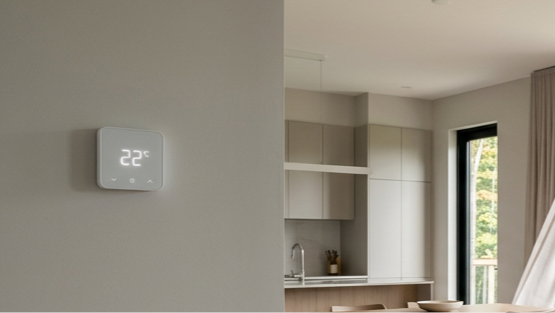
Comfort is not just the number on the thermostat. Two homes can both show 22°C and feel completely different. Humidity, airflow, sun exposure, insulation, ceiling height, and unit location all affect how the space feels.
A wall-mounted heat pump is visible inside the room. For many homeowners, that is not a problem. For others, appearance matters. A central system is usually more discreet because air comes through vents, but it requires functional ductwork.
Noise depends on the model, installation, placement, and usage. In both cases, planning helps avoid awkward choices, such as placing an indoor unit too close to a bed, desk, or quiet living space.
Energy efficiency: avoid overly simple answers
A wall-mounted heat pump can be very efficient in a well-chosen zone. A central HVAC system can also perform well when it is properly sized and properly distributed. The mistake is comparing only equipment labels without looking at the home.
A system that is too powerful may start and stop too often. A system that is too weak may run too long without reaching the desired comfort level. Either way, sizing matters. Choosing “bigger” may feel reassuring, but humans have a long tradition of making problems larger and then acting surprised.
Grants and planning
Some heat pump and central HVAC projects may be reviewed in the context of programs such as LogisVert. Eligibility depends on the equipment, home, installation, documentation, and current program rules.
Air Climatisation VS can help review possible options during the planning stage. The goal is not to promise automatic financial assistance, but to choose a system that makes sense for the home and the applicable requirements.
For planning support, you can also review the page about HVAC grants in Quebec if incentives are part of your project.
Why an on-site estimate often changes the answer
You can compare systems online, but the right answer depends on details that only a home assessment can confirm.
During an estimate, the technician should look at:
- Living area
- Number of floors
- Insulation
- Windows and sun exposure
- Ductwork condition
- Possible outdoor unit location
- Uncomfortable rooms
- Family habits
- Condo, yard, or exterior wall constraints
- Existing heating and cooling equipment
With 14 years in business, Air Climatisation VS has seen enough residential layouts to know that a universal answer is useful for slogans, not for actual comfort.
So, what should you choose on the South Shore?
Choose a wall-mounted heat pump if your priority is controlling a specific zone, if your home does not have ductwork, or if you want a less invasive solution for an open-concept area, condo, basement, or addition.
Choose a central HVAC system if your home already has good ductwork, if you want more even comfort across several rooms, or if you are planning a more complete heating and cooling upgrade.
In many South Shore homes, especially in Brossard, Longueuil, Saint-Lambert, and Greenfield Park, the best answer is not theoretical. It comes after checking the home layout, ductwork, difficult rooms, and comfort goals.
FAQ
Can a wall-mounted heat pump heat and cool an entire home?
Yes, in some cases, especially if the home is small, open, and well insulated. However, one wall-mounted heat pump may struggle to distribute air to closed bedrooms, hallways, or distant floors. For a larger home, it may be better to compare multiple zones with a central HVAC system.
Is a central HVAC system always better than a wall-mounted heat pump?
No. A central HVAC system can provide better whole-home distribution, but only if the ductwork is well designed and in good condition. For a condo, open-concept space, or home without ducts, a wall-mounted heat pump may be more practical.
Do you need existing ductwork for a central HVAC system?
Not always, but it is an important factor. Adding ductwork can require more work depending on the home. If ductwork already exists, it still needs to be checked for condition, sizing, and air distribution.
Book a FREE HVAC Estimation Visit
Not sure whether a wall-mounted heat pump or central HVAC system is the better fit for your South Shore home? Book a FREE HVAC Estimation Visit with Air Climatisation VS to compare options based on your home layout, ductwork, uncomfortable rooms, and comfort goals.