
By Tarik, Senior HVAC Specialist at Air Climatisation VS
Quick Takeaway
A heat pump does more than lower the temperature. During Quebec’s humid summers, it can also help remove some of the moisture from the indoor air.
In a Longueuil home, system sizing, runtime, and airflow can therefore matter just as much as the temperature shown on the thermostat.
A Home Can Feel Cool Without Feeling Comfortable
You set the thermostat to a comfortable temperature. The heat pump runs, reaches the setpoint, and shuts off.
But the air still feels heavy or sticky.
That does not necessarily mean the temperature is too high. Indoor humidity also plays an important role in how comfortable a home feels.
Think about two days with the same outdoor temperature. On a dry day, the air may feel fairly comfortable. On a very humid day, that same temperature can feel much less pleasant.
The same principle applies indoors.
A properly sized and well-planned heat pump can help maintain both a comfortable temperature and a more comfortable indoor humidity level during the cooling season.
How a Heat Pump Removes Humidity From the Air
When a heat pump operates in cooling mode, warm indoor air passes over a cold surface inside the indoor unit.
Some of the moisture in that air condenses, much like the droplets that form on a cold glass of water on a hot day.
That water is then carried away through the drainage system.
This process happens while the system is cooling the home. That is why heat pump runtime can affect dehumidification.
A system that runs for reasonably long cycles may have more time to remove moisture from the air than a system that constantly starts and stops.
Why Sizing Matters
It may seem logical to choose the most powerful heat pump possible.
After all, more capacity should mean more comfort, right?
Not necessarily.
An oversized heat pump may reach the requested temperature very quickly. It can then shut off before it has operated long enough to remove as much moisture as expected.
It is a bit like using a garden hose at full pressure to fill a small glass. You reach the goal quickly, but you do not control the process very well.
The sizing of a central HVAC system should take the home itself into account: floor area, insulation, windows, sun exposure, ductwork, and the actual comfort needs of the occupants.
The equipment’s rated capacity is only one part of the equation.
Airflow Also Affects Comfort
A heat pump can only condition the air that actually moves through the system.
In a central system, supply ducts distribute conditioned air while return air paths bring air back toward the equipment.
If some rooms receive a lot of airflow and others receive very little, comfort can vary significantly from one area to another.
A home can therefore have an acceptable average temperature while some rooms still feel warmer, more humid, or simply less comfortable.
In a multi-storey Longueuil home, this can be especially noticeable between the basement, main floor, and upstairs bedrooms.
Wall-Mounted Systems and Humidity
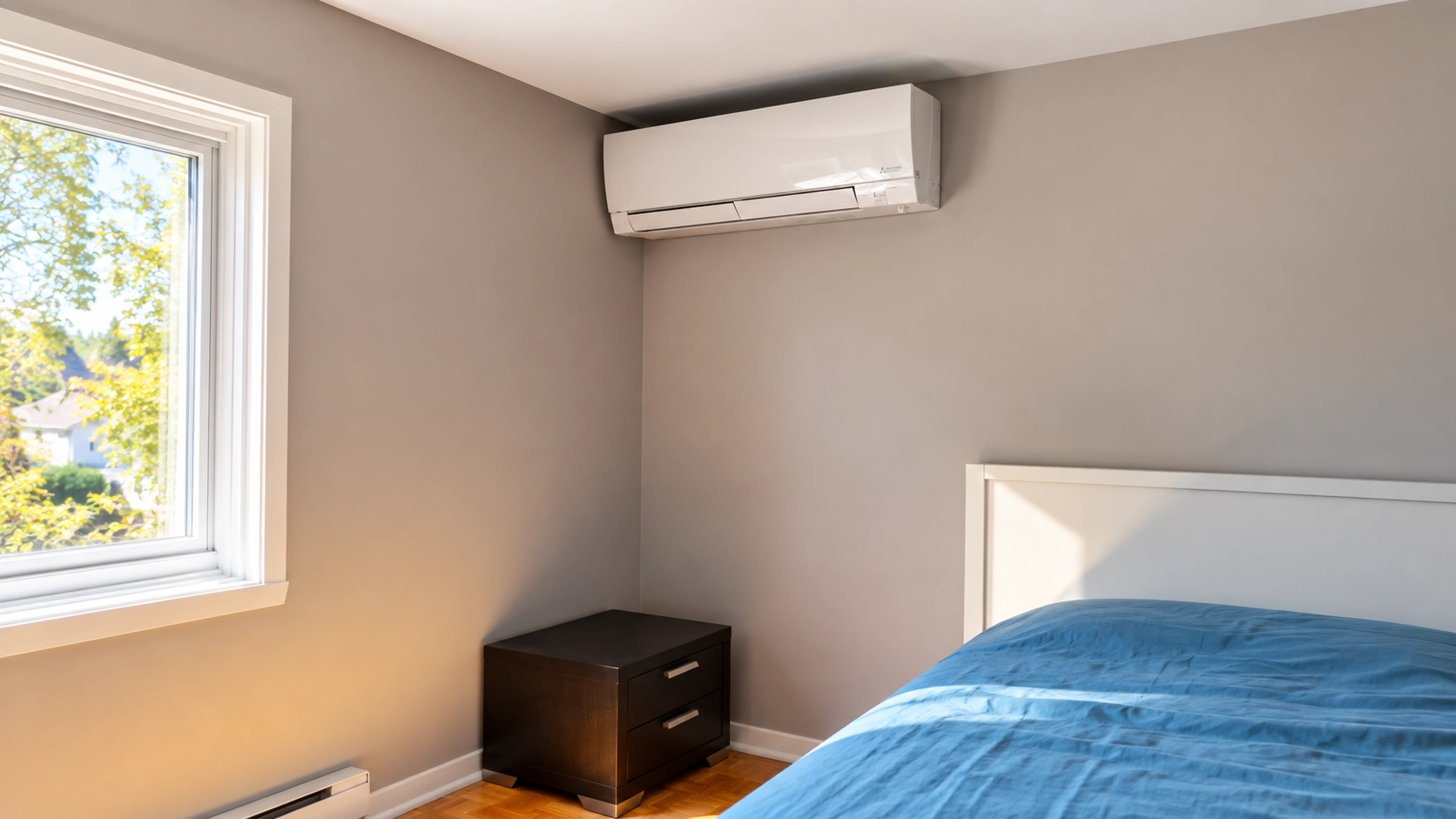
A wall-mounted heat pump also removes some moisture from the air while operating in cooling mode.
The main difference is that a wall-mounted unit primarily conditions the zone where it is installed.
In an open-concept area, one unit may sometimes serve a large space effectively. In a home with several closed bedrooms, hallways, or multiple floors, airflow becomes more complicated.
A unit installed in the living room cannot simply pull all the moisture out of a bedroom at the other end of the house with the door closed.
That is why the number of indoor units and their placement should be planned around the actual layout of the home.
Why Runtime Matters
A modern heat pump does not always run at full capacity.
Variable-capacity systems can adjust their output based on the needs of the home. When properly sized, they may run longer at reduced capacity instead of constantly starting and stopping.
That operating pattern can help maintain more stable temperatures and more consistent comfort.
The goal is not simply to cool a home as quickly as possible.
The real goal is to maintain stable indoor conditions.
Humidity Does Not Depend Only on the Heat Pump
The HVAC system matters, but it is not the only factor that affects indoor humidity.
Humidity can also be influenced by:
- the airtightness of the building;
- outdoor air infiltration;
- ventilation;
- cooking and showering habits;
- the basement;
- insulation;
- the number of occupants;
- doors and windows being left open.
Two homes of similar size in Longueuil can therefore have very different needs.
That is another reason why choosing equipment based only on square footage gives an incomplete picture.
Temperature and Comfort Are Not the Same Thing
The thermostat shows one value: the temperature near the point where it is installed.
But your body responds to a combination of conditions.
Temperature, humidity, air movement, and differences between rooms all affect comfort.
A home with a slightly higher temperature but better-controlled humidity may sometimes feel more comfortable than a colder home with very humid air.
That is why good HVAC planning looks at the whole building rather than a single number on the thermostat.
What an On-Site Estimate Can Help Confirm
Before choosing a new heat pump or replacing an existing system, an on-site visit can help review several factors that influence comfort.
Depending on the type of building, this may include:
- the size and layout of the home;
- the existing system;
- the condition and layout of the ductwork;
- return air paths;
- possible indoor unit locations;
- temperature differences between floors;
- building characteristics that affect heating and cooling loads.
The goal is not simply to choose a more powerful unit. It is to choose a system that suits the home.
FAQ
Does a heat pump work like a dehumidifier?
A heat pump naturally removes some moisture from the air while operating in cooling mode. However, its primary purpose is heating and cooling. The level of dehumidification depends on factors such as sizing, runtime, airflow, and conditions inside the home.
Does a more powerful heat pump control humidity better?
Not necessarily. An oversized unit may cool the home quickly and end its cycle sooner. A properly sized system can provide operating cycles that are better suited to maintaining both temperature and humidity comfort.
Why do some rooms stay more humid than others?
Airflow, room layout, closed doors, multiple floors, air infiltration, and unit placement can all create differences between zones. In a central system, ductwork and return air paths also play an important role.
Plan Comfort for Your Longueuil Home
Choosing a heat pump should not come down only to equipment capacity or the temperature listed on a specification sheet. Sizing, airflow, humidity, and the layout of the home all need to work together.
Book a FREE HVAC Estimation Visit with Air Climatisation VS to review the options that make sense for your Longueuil home.